on a mission:
Turning a cyber incident into a reason to talk to sales
The brief called for a virtual escape room — an interactive hospital security experience for trade-fair visitors. It was detailed, but felt largely AI-generated — the three zones only connected on the surface, several story beats asked questions they never answered, and the premise risked telling potential clients their own hospital had already failed.
00 Overview
Welcome to the Lab. Please Don’t Get Hacked
Problem
The three zones described in the brief were only superficially connected, the story had several plot holes, and the specified mechanics (puzzles, VFX, open-ended discovery) weren't realistic within the project's budget, timeline, and the more serious tone the client wanted.
Outcome
A reframed premise built around a preventive audit rather than an admitted breach, a simplified click-to-inspect interaction loop with lightweight quiz checks and an email interface that doubles as the experience's lead-capture mechanic.
Info
Project type: UX/UI & product design for a marketing and lead-generation experience
Medium: Large-format touchscreen (trade fairs); WebGL planned
Role: UX/UI & Product Designer
Team: 7
Disclaimer
Client details are anonymised under NDA.All visuals referenced are recreated or redacted to protect proprietary brand assets.
01 problem
Can a Marketing Pitch Survive Contact With Its Own Logic?
The company briefed us on a virtual escape room: players move through a hospital diagnostics lab hit by a simulated cyber incident, exploring three zones to find what let the breach happen and fix it. The brief was detailed, but it read as largely AI-generated: each zone opened with a question that was never answered, the three zones felt only superficially connected to one another, and the intended twist didn't hold up. Moreover, I found that it actually doesn’t inform the public about the product.
The project focus:
DIAGNOSING WHAT WOULDN'T WORK
Testing every mechanic proposed in the brief against real budget, timeline, and tone constraints before designing anything.
REWRITING THE PREMISE
Turning a breach story that risked alarming prospects into one that positioned the client as a protective partner instead.
BUILDING LEAD CAPTURE INTO THE STORY
Designing the marketing ask — a real email address — as something the narrative requests, not a form bolted on at the end.
02 Solution
Less Puzzle, More Detective Work
Before any zone design began, I pulled apart the brief and found a narrative with major plot holes, no resolution, and copy making feature claims the product couldn't support. Together with the project manager, I developed three distinct game and puzzle concepts to keep users engaged. When the client shifted from a gamified escape room to a simpler, more serious experience, we adapted the concepts to fit the new direction while retaining the strongest interaction ideas.
How do we engage the user in the experience?

PUZZLES/MINIGAMES - idea withdrawn by the client
VISUAL EFFECTS - no budget
OPEN-ENDED DISCOVERY - limited because the topic requires technical expertise → steep learning curve/entry point that is not to be achieved at a conference booth

STORY - the only lever left — with mechanics off the table, engagement has to come entirely from a narrative players could follow at a glance
A Story That Asked Questions and Never Answered Them
The existing story had real structural problems: unanswered questions, lack of flow, weak plot twist. I set four criteria for the rewrite and checked the original story against each.
RELATABLE
needed a risk lab managers and IT leads would recognise from their own daily work, not an abstract incident
MODERATE COMPLEXITY
as written, the points of interest were too dense for a few minutes of interaction
EASY TO FOLLOW
the three zones needed a visible throughline; as written, they connected superficially
LOGICAL
the plot holes and unanswered chapter questions needed resolving before any polish could help
Rewriting the Inciting Incident
Rather than have the breach happen at this hospital, I reframed the premise so the incident hits a different facility first — and this hospital's lab manager brings in the investigator - the player, to run a preventive audit.
This also changed the client's role in the story: instead of appearing only at the end as a fix for an admitted failure, the client's best-practice guidance becomes the tool the investigator uses throughout the audit — protection built in from the start.
WHAT I KEPT:
- The Investigator role: a persona the target audience could step into immediately
- The three-zone structure and the zones’ names.
- The core player loop: alert, explore, inspect, fix.
- The exploration-map elements (Points of Interest).
- The resolution where the client's product is presented as the fix.
WHAT I CHANGED:
- The inciting incident: from "this hospital was breached" to "another hospital was breached; audit yours before it happens here".
- The experience’s name: "Virtual Escape Room" promised puzzle-and-escape mechanics the final experience doesn't have, and risked disappointing conference attendees.
You’ve Got Mail: integrating lead generation
The brief called for lead capture through standalone "Email Intel Cards."
What I suggested

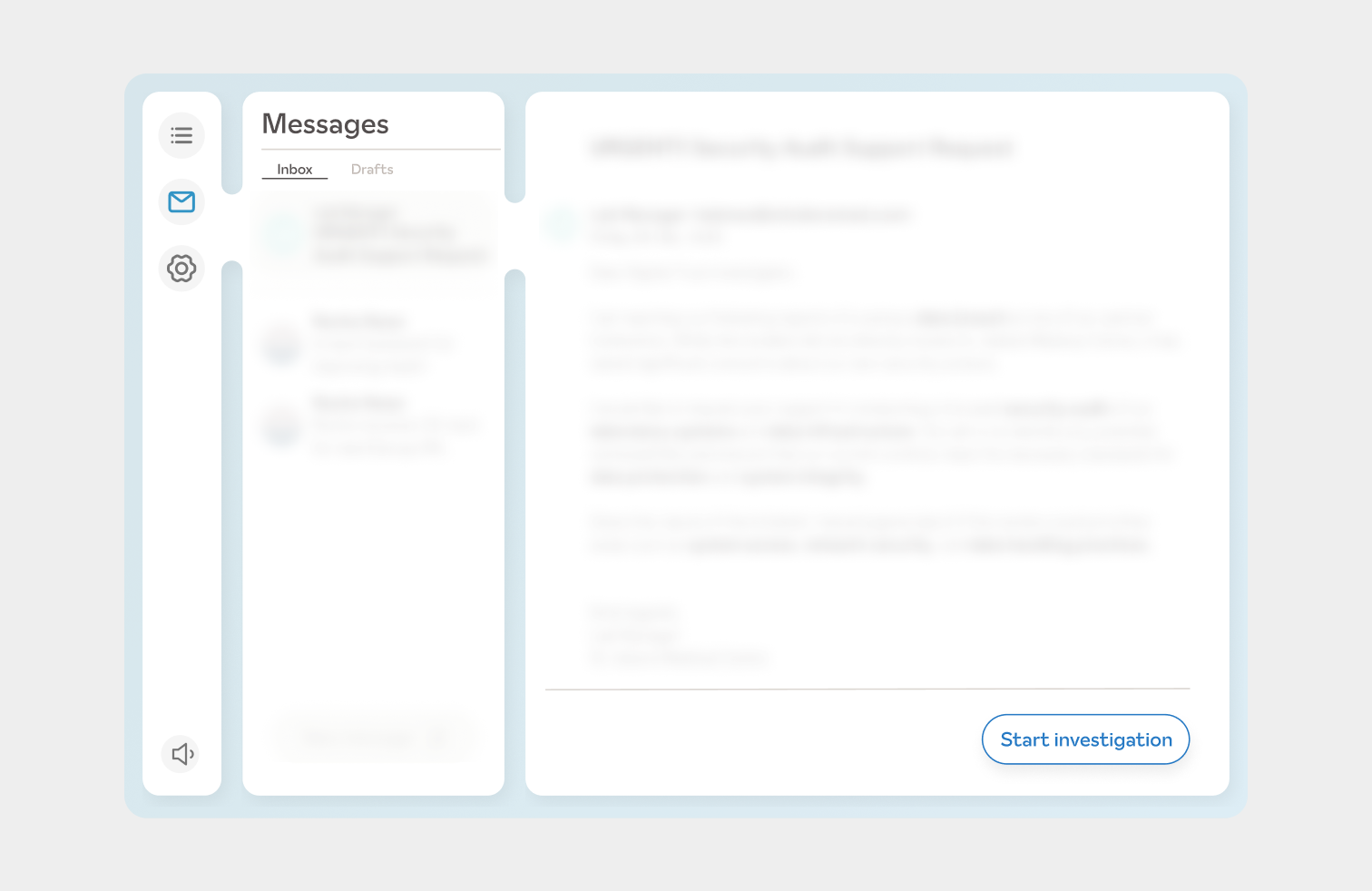
I designed the whole experience to open with a simplified email client where an email from the hospital's lab manager asks the player-investigator for help. The email interface becomes the natural place to capture a player's real address at the end, when the app offers to send them their investigation report. The marketing ask sits inside the fiction instead of interrupting it.
1 Sleek control center
Pattern everybody recognises. This simple email client is an integral part of the story and discovery mechanics. At the end of the experience it serves as a lead capture.
01
Welcome screen with initial message
2 Modular zones
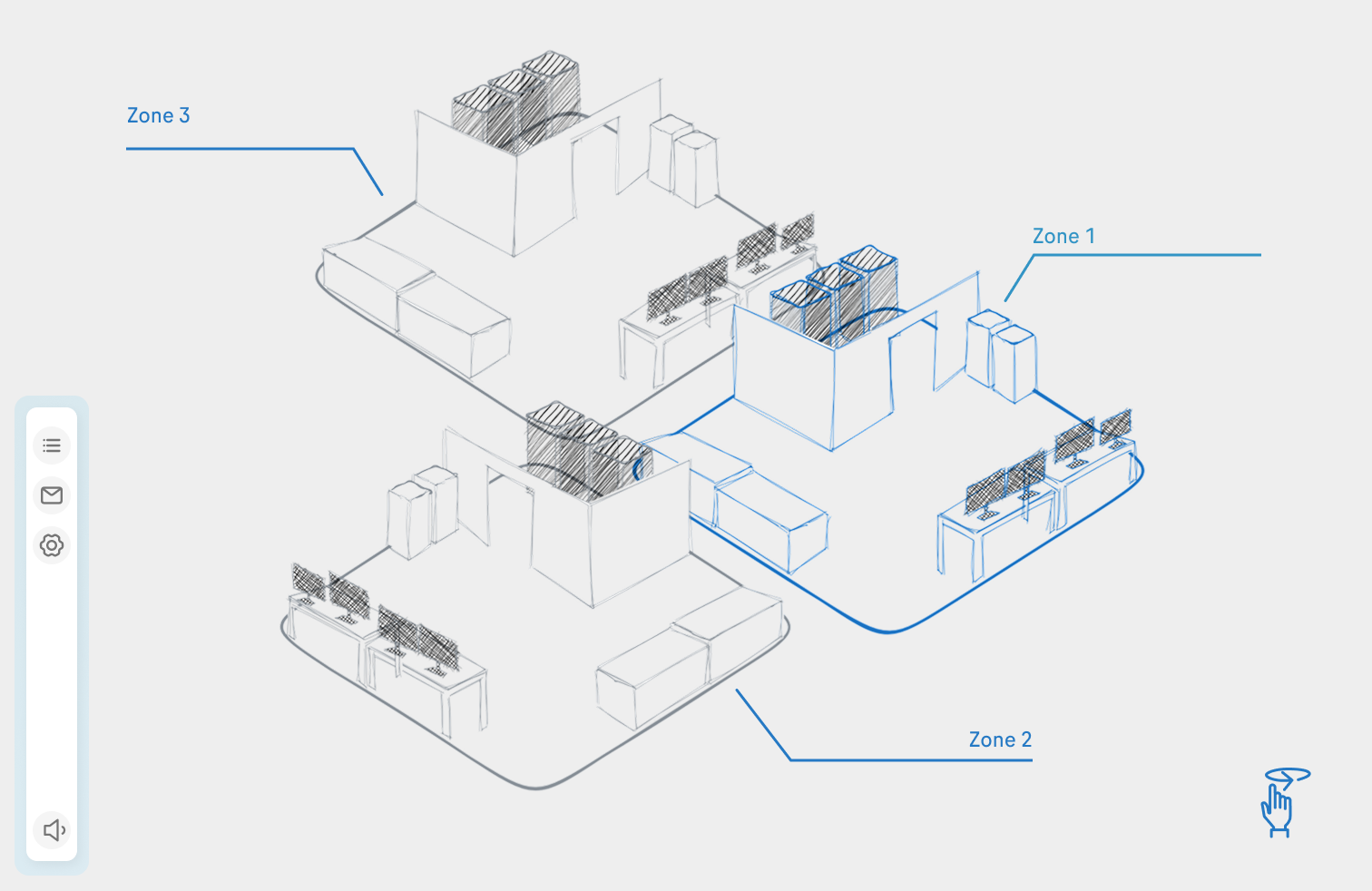
The experience consists of 3 zones that can be turned on and off (for example only Zone 1 is available at a conference as a teaser). Our skilful 3D artists and programmers have created modern assets and friendly, yet professional hospital scenes. Control panel is minimised, but always visible.
02
Wireframe of the zones overview
Micro interactions
The user gets a subtle feedback while selecting answers and clear CTA messages.
03
Correct answer reveals a confetti effect.
04
Wrong answer only gently suggests it was incorrect and reveals the correct answer.
03 Results
Almost at the Finish Line
The core experience is designed and implemented end to end — from the narrative and interaction system to all three zones and the supporting UI. Zone 3 is currently in its final finishing stage. The remaining technical dependency is automated email delivery, which is currently on hold due to blockers on the client’s side.
My impact:
Reframed the premise

Rewrote the inciting incident so prospects are invited to prevent a risk rather than confront one already realised at their own facility.

Made the scenario more credible and relevant to prospects, avoiding the implication that their organisation had already experienced a failure.
Built diverse interaction loops
Designed and shipped an alert → explore → inspect loop with lightweight yes/no and single-choice checks across all three zones.
Kept the experience engaging without complex puzzles: each step gives users a reason to investigate, make a decision and discover what happens next, rather than feeling like an obvious click-through.
Built lead capture into the fiction
Designed the entire experience around an in-universe email client, including the point where users provide their real email address.
Made the marketing CTA feel like a natural continuation of the story instead of an abrupt form at the end, reducing friction between the experience and lead capture.


A deep understanding of the product is the foundation of a successful digital experience.
Human judgement is still necessary to cross-check results delivered by generative AI, to ensure sound logic, clear flow, and good user experience.
Security check complete!
What would you investigate next?

on a mission:
Turning a cyber incident into a reason to talk to sales
The brief called for a virtual escape room — an interactive hospital security experience for trade-fair visitors. It was detailed, but felt largely AI-generated — the three zones only connected on the surface, several story beats asked questions they never answered, and the premise risked telling potential clients their own hospital had already failed.
00
Overview
Welcome to the Lab. Please Don’t Get Hacked
Problem
The three zones described in the brief were only superficially connected, the story had several plot holes, and the specified mechanics (puzzles, VFX, open-ended discovery) weren't realistic within the project's budget, timeline, and the more serious tone the client wanted.
Outcome
A reframed premise built around a preventive audit rather than an admitted breach, a simplified click-to-inspect interaction loop with lightweight quiz checks and an email interface that doubles as the experience's lead-capture mechanic.
Info
Project type: UX/UI & product design for a marketing and lead-generation experience
Medium: Large-format touchscreen (trade fairs); WebGL planned
Role: UX/UI & Product Designer
Team: 7
Disclaimer
Client details are anonymised under NDA.All visuals referenced are recreated or redacted to protect proprietary brand assets.
01
problem
Can a Marketing Pitch Survive Contact With Its Own Logic?
The company briefed us on a virtual escape room: players move through a hospital diagnostics lab hit by a simulated cyber incident, exploring three zones to find what let the breach happen and fix it. The brief was detailed, but it read as largely AI-generated: each zone opened with a question that was never answered, the three zones felt only superficially connected to one another, and the intended twist didn't hold up. Moreover, I found that it actually doesn’t inform the public about the product.
The project focus:
DIAGNOSING WHAT WOULDN'T WORK
Testing every mechanic proposed in the brief against real budget, timeline, and tone constraints before designing anything.
REWRITING THE PREMISE
Turning a breach story that risked alarming prospects into one that positioned the client as a protective partner instead.
BUILDING LEAD CAPTURE INTO THE STORY
Designing the marketing ask — a real email address — as something the narrative requests, not a form bolted on at the end.
02
Solution
Less Puzzle, More Detective Work
Before any zone design began, I pulled apart the brief and found a narrative with major plot holes, no resolution, and copy making feature claims the product couldn't support. Together with the project manager, I developed three distinct game and puzzle concepts to keep users engaged. When the client shifted from a gamified escape room to a simpler, more serious experience, we adapted the concepts to fit the new direction while retaining the strongest interaction ideas.
How do we engage the user in the experience?
PUZZLES/MINIGAMES - idea withdrawn by the client
VISUAL EFFECTS - no budget
OPEN-ENDED DISCOVERY - limited because the topic requires technical expertise → steep learning curve/entry point that is not to be achieved at a conference booth
STORY - the only lever left — with mechanics off the table, engagement has to come entirely from a narrative players could follow at a glance
A Story That Asked Questions and Never Answered Them
The existing story had real structural problems: unanswered questions, lack of flow, weak plot twist. I set four criteria for the rewrite and checked the original story against each.
RELATABLE
needed a risk lab managers and IT leads would recognise from their own daily work, not an abstract incident
MODERATE COMPLEXITY
as written, the points of interest were too dense for a few minutes of interaction
EASY TO FOLLOW
the three zones needed a visible throughline; as written, they connected superficially
LOGICAL
the plot holes and unanswered chapter questions needed resolving before any polish could help
Rewriting the Inciting Incident
Rather than have the breach happen at this hospital, I reframed the premise so the incident hits a different facility first — and this hospital's lab manager brings in the investigator - the player, to run a preventive audit.
This also changed the client's role in the story: instead of appearing only at the end as a fix for an admitted failure, the client's best-practice guidance becomes the tool the investigator uses throughout the audit — protection built in from the start.
WHAT I KEPT:
- The Investigator role: a persona the target audience could step into immediately
- The three-zone structure and the zones’ names.
- The core player loop: alert, explore, inspect, fix.
- The exploration-map elements (Points of Interest).
- The resolution where the client's product is presented as the fix.
WHAT I CHANGED:
- The inciting incident: from "this hospital was breached" to "another hospital was breached; audit yours before it happens here".
- The experience’s name: "Virtual Escape Room" promised puzzle-and-escape mechanics the final experience doesn't have, and risked disappointing conference attendees.
You’ve Got Mail: integrating lead generation
The brief called for lead capture through standalone "Email Intel Cards."
What I suggested

I designed the whole experience to open with a simplified email client where an email from the hospital's lab manager asks the player-investigator for help. The email interface becomes the natural place to capture a player's real address at the end, when the app offers to send them their investigation report. The marketing ask sits inside the fiction instead of interrupting it.
1 Sleek control center
Pattern everybody recognises. This simple email client is an integral part of the story and discovery mechanics. At the end of the experience it serves as a lead capture.
01
Welcome screen with initial message
02
Wireframe of the zones overview
2 Modular zones
The experience consists of 3 zones that can be turned on and off (for example only Zone 1 is available at a conference as a teaser). Our skilful 3D artists and programmers have created modern assets and friendly, yet professional hospital scenes. Control panel is minimised, but always visible.
Micro interactions
The user gets a subtle feedback while selecting answers and clear CTA messages.
03
Correct answer reveals a confetti effect.
04
Wrong answer only gently suggests it was incorrect and reveals the correct answer.
03
Results
Almost at the Finish Line
The core experience is designed and implemented end to end — from the narrative and interaction system to all three zones and the supporting UI. Zone 3 is currently in its final finishing stage. The remaining technical dependency is automated email delivery, which is currently on hold due to blockers on the client’s side.
My impact:
Reframed the premise
Rewrote the inciting incident so prospects are invited to prevent a risk rather than confront one already realised at their own facility.

Made the scenario more credible and relevant to prospects, avoiding the implication that their organisation had already experienced a failure.
Built diverse interaction loops
Designed and shipped an alert → explore → inspect loop with lightweight yes/no and single-choice checks across all three zones.
Kept the experience engaging without complex puzzles: each step gives users a reason to investigate, make a decision and discover what happens next, rather than feeling like an obvious click-through.
Built lead capture into the fiction
Designed the entire experience around an in-universe email client, including the point where users provide their real email address.
Made the marketing CTA feel like a natural continuation of the story instead of an abrupt form at the end, reducing friction between the experience and lead capture.


A deep understanding of the product is the foundation of a successful digital experience.
Human judgement is still necessary to cross-check results delivered by generative AI, to ensure sound logic, clear flow, and good user experience.
Security check complete!
What would you investigate next?

on a mission:
Turning a cyber incident into a reason to talk to sales
The brief called for a virtual escape room — an interactive hospital security experience for trade-fair visitors. It was detailed, but felt largely AI-generated — the three zones only connected on the surface, several story beats asked questions they never answered, and the premise risked telling potential clients their own hospital had already failed.
00
Overview
Welcome to the Lab. Please Don’t Get Hacked
Problem
The three zones described in the brief were only superficially connected, the story had several plot holes, and the specified mechanics (puzzles, VFX, open-ended discovery) weren't realistic within the project's budget, timeline, and the more serious tone the client wanted.
Outcome
A reframed premise built around a preventive audit rather than an admitted breach, a simplified click-to-inspect interaction loop with lightweight quiz checks and an email interface that doubles as the experience's lead-capture mechanic.
Info
Project type: UX/UI & product design for a marketing and lead-generation experience
Medium: Large-format touchscreen (trade fairs); WebGL planned
Role: UX/UI & Product Designer
Team: 7
Disclaimer
Client details are anonymised under NDA.All visuals referenced are recreated or redacted to protect proprietary brand assets.
01
problem
Can a Marketing Pitch Survive Contact With Its Own Logic?
The company briefed us on a virtual escape room: players move through a hospital diagnostics lab hit by a simulated cyber incident, exploring three zones to find what let the breach happen and fix it. The brief was detailed, but it read as largely AI-generated: each zone opened with a question that was never answered, the three zones felt only superficially connected to one another, and the intended twist didn't hold up. Moreover, I found that it actually doesn’t inform the public about the product.
The project focus:
DIAGNOSING WHAT WOULDN'T WORK
Testing every mechanic proposed in the brief against real budget, timeline, and tone constraints before designing anything.
REWRITING THE PREMISE
Turning a breach story that risked alarming prospects into one that positioned the client as a protective partner instead.
BUILDING LEAD CAPTURE INTO THE STORY
Designing the marketing ask — a real email address — as something the narrative requests, not a form bolted on at the end.
02
Solution
Less Puzzle, More Detective Work
Before any zone design began, I pulled apart the brief and found a narrative with major plot holes, no resolution, and copy making feature claims the product couldn't support. Together with the project manager, I developed three distinct game and puzzle concepts to keep users engaged. When the client shifted from a gamified escape room to a simpler, more serious experience, we adapted the concepts to fit the new direction while retaining the strongest interaction ideas.
How do we engage the user in the experience?
PUZZLES/MINIGAMES - idea withdrawn by the client
VISUAL EFFECTS - no budget
OPEN-ENDED DISCOVERY - limited because the topic requires technical expertise → steep learning curve/entry point that is not to be achieved at a conference booth
STORY - the only lever left — with mechanics off the table, engagement has to come entirely from a narrative players could follow at a glance
A Story That Asked Questions and Never Answered Them
The existing story had real structural problems: unanswered questions, lack of flow, weak plot twist. I set four criteria for the rewrite and checked the original story against each.
RELATABLE
needed a risk lab managers and IT leads would recognise from their own daily work, not an abstract incident
MODERATE COMPLEXITY
as written, the points of interest were too dense for a few minutes of interaction
EASY TO FOLLOW
the three zones needed a visible throughline; as written, they connected superficially
LOGICAL
the plot holes and unanswered chapter questions needed resolving before any polish could help
Rewriting the Inciting Incident
Rather than have the breach happen at this hospital, I reframed the premise so the incident hits a different facility first — and this hospital's lab manager brings in the investigator - the player, to run a preventive audit.
This also changed the client's role in the story: instead of appearing only at the end as a fix for an admitted failure, the client's best-practice guidance becomes the tool the investigator uses throughout the audit — protection built in from the start.
WHAT I KEPT:
- The Investigator role: a persona the target audience could step into immediately
- The three-zone structure and the zones’ names.
- The core player loop: alert, explore, inspect, fix.
- The exploration-map elements (Points of Interest).
- The resolution where the client's product is presented as the fix.
WHAT I CHANGED:
- The inciting incident: from "this hospital was breached" to "another hospital was breached; audit yours before it happens here".
- The experience’s name: "Virtual Escape Room" promised puzzle-and-escape mechanics the final experience doesn't have, and risked disappointing conference attendees.
You’ve Got Mail: integrating lead generation
The brief called for lead capture through standalone "Email Intel Cards."
What I suggested
I designed the whole experience to open with a simplified email client where an email from the hospital's lab manager asks the player-investigator for help. The email interface becomes the natural place to capture a player's real address at the end, when the app offers to send them their investigation report. The marketing ask sits inside the fiction instead of interrupting it.
1 Sleek control center
Pattern everybody recognises. This simple email client is an integral part of the story and discovery mechanics. At the end of the experience it serves as a lead capture.
01
Welcome screen with initial message
02
Wireframe of the zones overview
2 Modular zones
The experience consists of 3 zones that can be turned on and off (for example only Zone 1 is available at a conference as a teaser). Our skilful 3D artists and programmers have created modern assets and friendly, yet professional hospital scenes. Control panel is minimised, but always visible.
Micro interactions
The user gets a subtle feedback while selecting answers and clear CTA messages.
03
Correct answer reveals a confetti effect.
04
Wrong answer only gently suggests it was incorrect and reveals the correct answer.
03
Results
Almost at the Finish Line
The core experience is designed and implemented end to end — from the narrative and interaction system to all three zones and the supporting UI. Zone 3 is currently in its final finishing stage. The remaining technical dependency is automated email delivery, which is currently on hold due to blockers on the client’s side.
My impact:
Reframed the premise
Rewrote the inciting incident so prospects are invited to prevent a risk rather than confront one already realised at their own facility.
Made the scenario more credible and relevant to prospects, avoiding the implication that their organisation had already experienced a failure.
Built diverse interaction loops
Designed and shipped an alert → explore → inspect loop with lightweight yes/no and single-choice checks across all three zones.
Kept the experience engaging without complex puzzles: each step gives users a reason to investigate, make a decision and discover what happens next, rather than feeling like an obvious click-through.
Built lead capture into the fiction
Designed the entire experience around an in-universe email client, including the point where users provide their real email address.
Made the marketing CTA feel like a natural continuation of the story instead of an abrupt form at the end, reducing friction between the experience and lead capture.

A deep understanding of the product is the foundation of a successful digital experience.
Human judgement is still necessary to cross-check results delivered by generative AI, to ensure sound logic, clear flow, and good user experience.
Security check complete!
What would you investigate next?
Process:

on a mission:
Turning a cyber incident into a reason to talk to sales
The brief called for a virtual escape room — an interactive hospital security experience for trade-fair visitors. It was detailed, but felt largely AI-generated — the three zones only connected on the surface, several story beats asked questions they never answered, and the premise risked telling potential clients their own hospital had already failed.
Process:
00
Overview
Welcome to the Lab. Please Don’t Get Hacked
Problem
The three zones described in the brief were only superficially connected, the story had several plot holes, and the specified mechanics (puzzles, VFX, open-ended discovery) weren't realistic within the project's budget, timeline, and the more serious tone the client wanted.
Outcome
A reframed premise built around a preventive audit rather than an admitted breach, a simplified click-to-inspect interaction loop with lightweight quiz checks and an email interface that doubles as the experience's lead-capture mechanic.
Info
Project type: UX/UI & product design for a marketing and lead-generation experience
Medium: Large-format touchscreen (trade fairs); WebGL planned
Role: UX/UI & Product Designer
Team: 7
Disclaimer
Client details are anonymised under NDA.All visuals referenced are recreated or redacted to protect proprietary brand assets.
01
problem
Can a Marketing Pitch Survive Contact With Its Own Logic?
The company briefed us on a virtual escape room: players move through a hospital diagnostics lab hit by a simulated cyber incident, exploring three zones to find what let the breach happen and fix it. The brief was detailed, but it read as largely AI-generated: each zone opened with a question that was never answered, the three zones felt only superficially connected to one another, and the intended twist didn't hold up. Moreover, I found that it actually doesn’t inform the public about the product.
The project focus:
DIAGNOSING WHAT WOULDN'T WORK
Testing every mechanic proposed in the brief against real budget, timeline, and tone constraints before designing anything.
REWRITING THE PREMISE
Turning a breach story that risked alarming prospects into one that positioned the client as a protective partner instead.
BUILDING LEAD CAPTURE INTO THE STORY
Designing the marketing ask — a real email address — as something the narrative requests, not a form bolted on at the end.
02
Solution
Less Puzzle, More Detective Work
Before any zone design began, I pulled apart the brief and found a narrative with major plot holes, no resolution, and copy making feature claims the product couldn't support. Together with the project manager, I developed three distinct game and puzzle concepts to keep users engaged. When the client shifted from a gamified escape room to a simpler, more serious experience, we adapted the concepts to fit the new direction while retaining the strongest interaction ideas.
How do we engage the user in the experience?
PUZZLES/MINIGAMES - idea withdrawn by the client
VISUAL EFFECTS - no budget
OPEN-ENDED DISCOVERY - limited because the topic requires technical expertise → steep learning curve/entry point that is not to be achieved at a conference booth
STORY - the only lever left — with mechanics off the table, engagement has to come entirely from a narrative players could follow at a glance
A Story That Asked Questions and Never Answered Them
The existing story had real structural problems: unanswered questions, lack of flow, weak plot twist. I set four criteria for the rewrite and checked the original story against each.
RELATABLE
needed a risk lab managers and IT leads would recognise from their own daily work, not an abstract incident
MODERATE COMPLEXITY
as written, the points of interest were too dense for a few minutes of interaction
EASY TO FOLLOW
the three zones needed a visible throughline; as written, they connected superficially
LOGICAL
the plot holes and unanswered chapter questions needed resolving before any polish could help
Rewriting the Inciting Incident
Rather than have the breach happen at this hospital, I reframed the premise so the incident hits a different facility first — and this hospital's lab manager brings in the investigator - the player, to run a preventive audit.
This also changed the client's role in the story: instead of appearing only at the end as a fix for an admitted failure, the client's best-practice guidance becomes the tool the investigator uses throughout the audit — protection built in from the start.
WHAT I KEPT:
- The Investigator role: a persona the target audience could step into immediately
- The three-zone structure and the zones’ names.
- The core player loop: alert, explore, inspect, fix.
- The exploration-map elements (Points of Interest).
- The resolution where the client's product is presented as the fix.
WHAT I CHANGED:
- The inciting incident: from "this hospital was breached" to "another hospital was breached; audit yours before it happens here".
- The experience’s name: "Virtual Escape Room" promised puzzle-and-escape mechanics the final experience doesn't have, and risked disappointing conference attendees.
You’ve Got Mail: integrating lead generation
The brief called for lead capture through standalone "Email Intel Cards."
What I suggested
I designed the whole experience to open with a simplified email client where an email from the hospital's lab manager asks the player-investigator for help. The email interface becomes the natural place to capture a player's real address at the end, when the app offers to send them their investigation report. The marketing ask sits inside the fiction instead of interrupting it.
1 Sleek control center
Pattern everybody recognises. This simple email client is an integral part of the story and discovery mechanics. At the end of the experience it serves as a lead capture.
01
Welcome screen with initial message
02
Wireframe of the zones overview
2 Modular zones
The experience consists of 3 zones that can be turned on and off (for example only Zone 1 is available at a conference as a teaser). Our skilful 3D artists and programmers have created modern assets and friendly, yet professional hospital scenes. Control panel is minimised, but always visible.
Micro interactions
The user gets a subtle feedback while selecting answers and clear CTA messages.
03
Correct answer reveals a confetti effect.
04
Wrong answer only gently suggests it was incorrect and reveals the correct answer.
03
Results
Almost at the Finish Line
The core experience is designed and implemented end to end — from the narrative and interaction system to all three zones and the supporting UI. Zone 3 is currently in its final finishing stage. The remaining technical dependency is automated email delivery, which is currently on hold due to blockers on the client’s side.
My impact:
Reframed the premise
Rewrote the inciting incident so prospects are invited to prevent a risk rather than confront one already realised at their own facility.
Made the scenario more credible and relevant to prospects, avoiding the implication that their organisation had already experienced a failure.
Built diverse interaction loops
Designed and shipped an alert → explore → inspect loop with lightweight yes/no and single-choice checks across all three zones.
Kept the experience engaging without complex puzzles: each step gives users a reason to investigate, make a decision and discover what happens next, rather than feeling like an obvious click-through.
Built lead capture into the fiction
Designed the entire experience around an in-universe email client, including the point where users provide their real email address.
Made the marketing CTA feel like a natural continuation of the story instead of an abrupt form at the end, reducing friction between the experience and lead capture.
A deep understanding of the product is the foundation of a successful digital experience.
Human judgement is still necessary to cross-check results delivered by generative AI, to ensure sound logic, clear flow, and good user experience.
Security check complete!
What would you investigate next?