on a mission:
Helping fellow travellers find a pillow to rest their head anywhere in the world.
It starts with a friend’s Kafkaesque hostel booking anecdote shared as Alex and I are joking about tackling a side project together. Alex happens to be a seasoned hostel-goer and we start trading tales. From there, the concept for BunkQuest begins to take shape.
00 Overview
From Overwhelmed to Streamlined: Rethinking Hostel Booking
Problem
Travellers book hostels more than ever, yet finding the right fit often feels overwhelming. Hidden filters, unclear listings, and hotel-heavy results make the search harder than it should be.
Outcome
A clearer, hostel-first experience that removes confusion, makes filters visible and relevant, and helps travellers quickly find the right stay without wading through hotel-heavy results.
Info
Project type: UX/UI, “Add a Feature”
Medium: Mobile application
Role: UX/UI Designer, Researcher
Team: 2
Disclaimer
This project is a conceptual side project made for learning and portfolio purposes. It’s inspired by Booking.com, but not created by, connected to, or officially endorsed by them.

When I recently booked a trip to Copenhagen,I really found myself missing the filtering options for hostels.
01 problem
The Future Belongs to Budget Adventurers
Solo travel, once considered niche,
now draws diverse demographics, including more women and older age groups. Surveys indicate around 27% of people planning trips now wish to travel independently - a figure that has doubled in recent years.
01
Over the next decade, the number of solo travellers is projected to increase significantly, with many choosing to travel for longer periods.
(Solo*) travellers habits:
1*
Hostels remain their top choice - not only for affordability but also for the sense of community they provide.
2*
Travellers are booking hostels further in advance: 3–6 months or even 6–12 months ahead of their trips.
3
Over 65% of global travel bookings are made via mobile devices.
4
Younger travellers prefer mobile apps for booking due to convenience and personalised services.
Opportunity:
Booking.com is one of the biggest and most trusted booking platforms in the world, but the way people are traveling is changing. We saw an opportunity to make the platform a part of that shift, addressing the growing demand for budget-friendly options and the unique needs of modern travellers.
GoalS:
- Enable travellers to find hostels faster by introducing hostel-specific filters.
- Support travellers in making confident booking decisions by providing more detailed and relevant hostel reviews.
User Interviews: Why Finding Hostels Feels Harder Than It Should
Interviews revealed that travellers struggle to find hostel listings on Booking.com. Limited filters, low visibility, and unclear categorisation - shaped by the platform’s hotel-first design - make discovery difficult.
- Many users are unaware of the “hostel” property type filter.
- The hostel filter is ambiguous and doesn’t fully separate hostels from other accommodation types.
- The filter only works if properties are correctly categorised as hostels - many are not.
- Travellers booking with friends struggle to find hostels, as the search function defaults to shared private rooms instead of dorm beds.
What’s Really on a Traveller’s Checklist

JOB TO BE DONE - Finding a Hostel
When I am travelling

I want to easily book a hostel stay
because I am on a budget
so I can have an affordable place to sleep.
Traveller goals & motivationS

See only the options I can afford.
Access hostel information that fits my preferences.
Traveller Challenges
Identifying which properties are hostels vs hotels.
Important details like amenities buried in descriptions and reviews.
“Help me book faster and error-free
so I can focus on enjoying my trip and stay within my budget.”

During our initial interviews we came in thinking that our main goal would be to improve the filtering options specific to hostels, but we discovered that users also rely heavily on reviews to access valuable information about hostels.

JOB TO BE DONE - Leaving a review
When I am travelling
I want to leave quick and informative reviews
because I rely on reviews when making my choices
so I want to help others make informed decisions.
Traveller goals & motivationS
I count on reviews, so I make sure to contribute too.
Share insights without writing a lot.
Traveller Challenges
Some reviews are very generic.
Reviews require effort I can’t spare when travelling.
“Help me book faster and error-free
so I can focus on enjoying my trip and stay within my budget.”

Our initial focus was on creating a “Hostel Mode” with better filtering, but the research showed us that reviews and tags mattered just as much. After all, a trip doesn’t start with the flight and end when you get home -
it begins with research and ends with the review you leave behind.
02 Solution
From Hostel Headaches to Hostel Mode
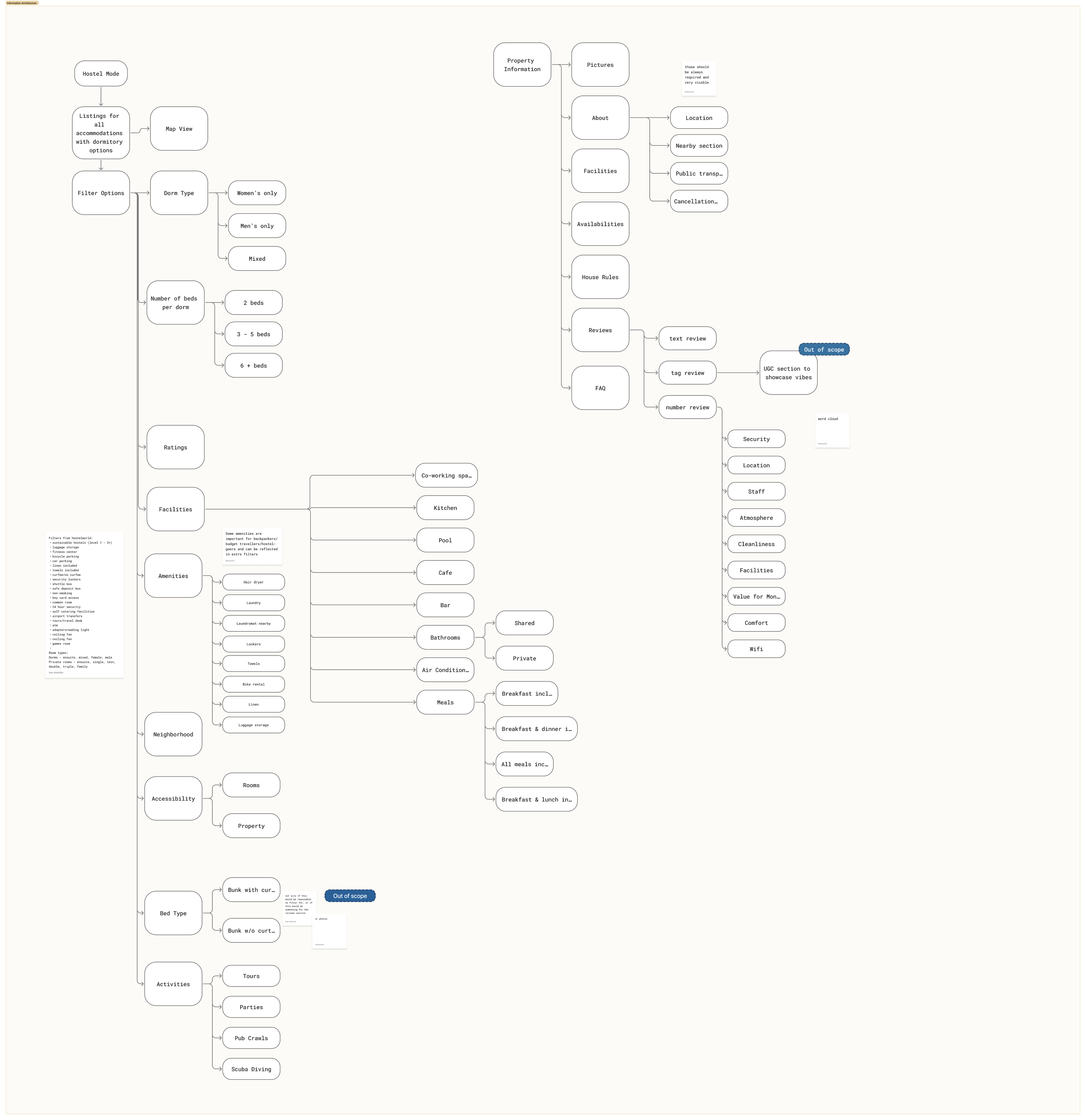
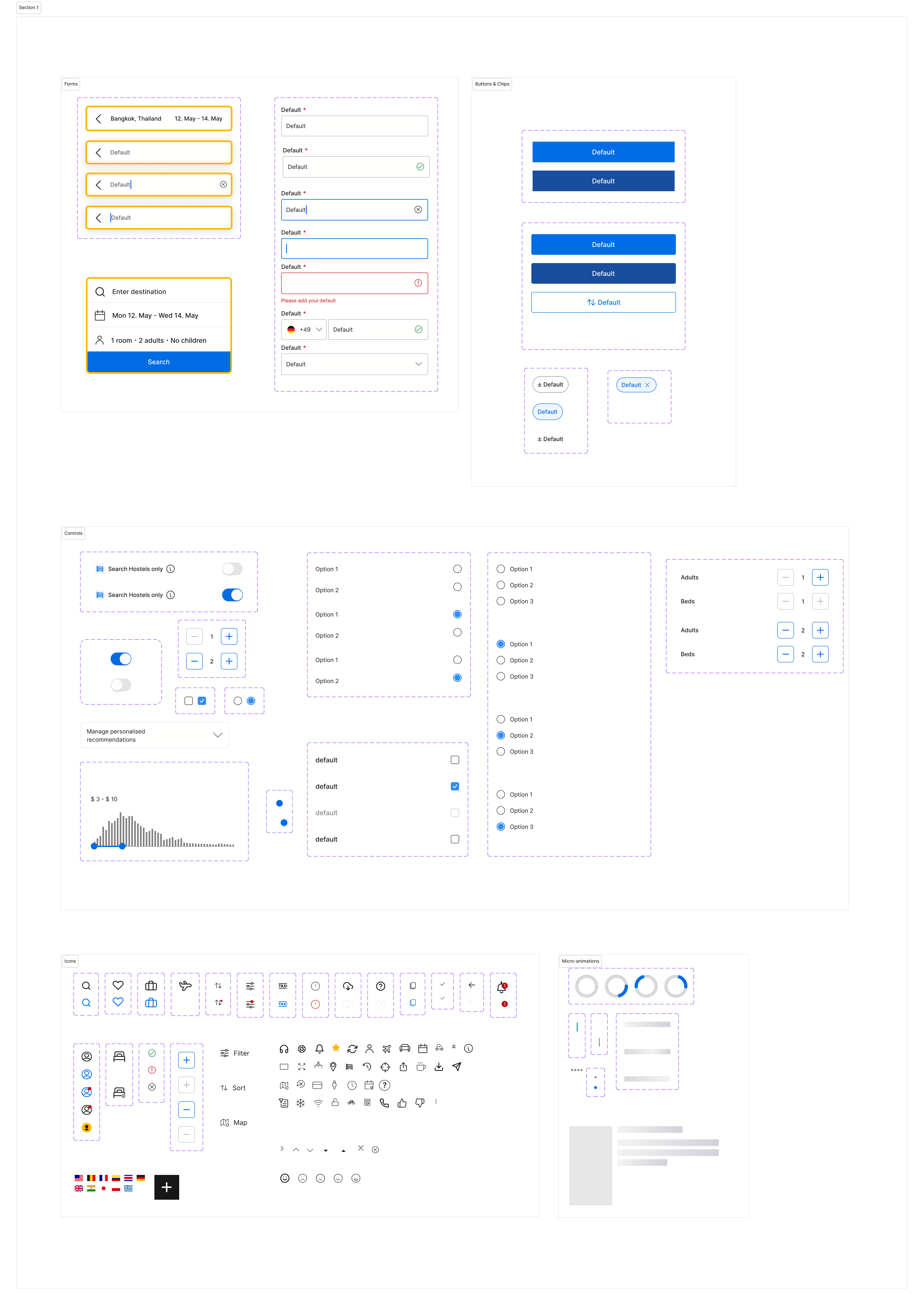
One of the biggest challenges we faced was working within the established Booking.com design system. Rather than reinventing the interface, we had to carefully recreate the existing UI and integrate new features in a way that felt native and seamless. This meant paying close attention to typography, spacing, iconography, and interaction patterns so that our hostel-focused additions blended naturally into the platform.
02
Integrating new features within existing information architecture
03
Working within the Booking.com design system
Turning Insights into Features
To address the traveller needs identified in our research, we developed several solutions:
1 Hostel Mode
Search hostels only, book by bed instead of room.
Questions raised

- Where should users decide to book a hostel, and where does it make sense to introduce this option?
- How can we add a new feature that is accessible, intuitive, and requires minimal explanation?
- How do we make it visible for hostel users without disrupting the experience for non-hostel users?
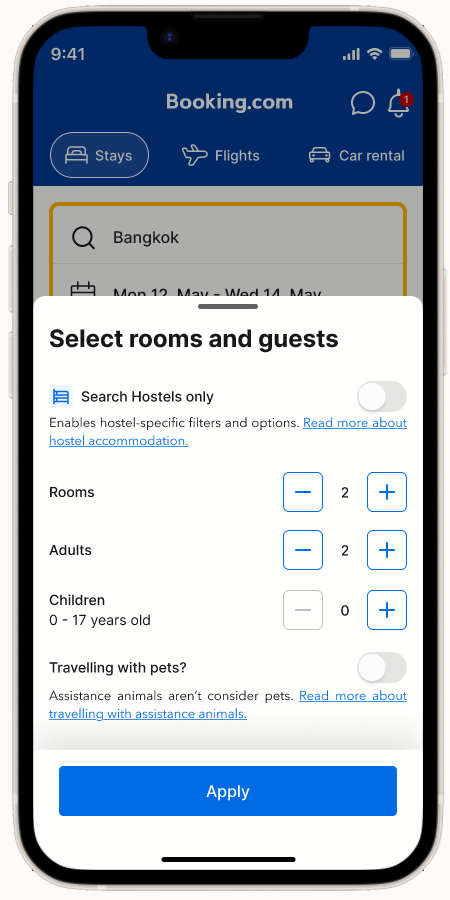
- How can we adapt the Rooms & Guests section, since hostel guests book by bed rather than by room?
- How can we design the toggle so it feels familiar and consistent (inspired by existing design choices, e.g. the “Pets” toggle)?
2 Hostel-specific filters
Find properties that meet traveller needs faster
Decisions & Considerations
- Added filters for mixed dorms, female-only dorms, male-only dorms etc.
- Considered filters for social/party hostels versus quiet/relaxed hostels.
- Looked at adding filters for common kitchen, lockers, laundry, Wi-Fi, 24h reception, and air conditioning.
- Made sure hostel filters felt like a natural extension of existing ones, not a separate or overwhelming layer.
3 Property Page & Vibe Cloud
Highlights what past guests loved most, at a glance.
Decisions & Considerations
- Adjusted the property page to display hostel-relevant details more prominently.
- Highlighted “bed in dorm” options directly in property lists.
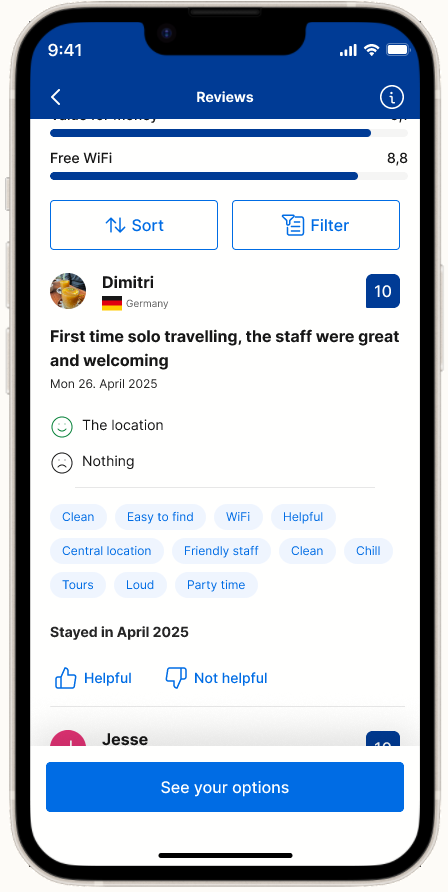
- Created tags styled consistently with Booking.com’s existing tags, but non-clickable (to avoid confusion with filters or deletions).
- Adjusted individual reviews to display tags at the bottom.
4 Improved review flow
Makes it easier to leave feedback that feeds into the Vibe Cloud.
Questions raised
- How do we make leaving a review less time-consuming while still gathering meaningful insights?
- How can reviews highlight social and community aspects unique to hostels, not just facilities?
- How do we encourage more travellers to leave reviews without making it feel like extra work?
- Should tags be user-generated or system-suggested (to keep language consistent)?
- How do we make the review process feel consistent with Booking.com’s current flow, while still adding hostel-specific elements?
03 Results
First Check-In: What Our Travellers Told Us
We set up Maze tests and shared our first prototype with trusted travellers. Their feedback guided us as we refined and iterated on the design.
Adjustments we made:
- Tag placement in reviews (separation line).
- Extra information about hostel mode.
- Adjust the review process steps.
- Design the tag system to be neutral-to-positive by default, since selecting tags is an opt-in action. This keeps the “vibe cloud” constructive and easy to scan.
Design choices we decided to keep, despite user feedback and why:
Two out of three interviewees suggested sorting the tags by sentiment. However, when we explored how this might be implemented, we realised it wouldn’t be realistic - tags are highly subjective, and what feels positive to one traveller might be negative to another.
04
Additional information about the new feature
05
Updated review process split into shorter steps
Evaluation:
People aren’t likely to notice changes if they are integrated and closely aligned with the existing design.
Our changes were not disruptive and participants sometimes couldn’t distinguish between what was part of Booking.com’s original design and what was our addition.

I wanted to do the [Maze] test, but it just opened Booking.com...

Listening Between the Lines
Sometimes the best ideas hide in the things users casually mention between lines. By keeping our ears open and our assumptions at the door, we stumbled upon problems—and solutions—we hadn’t even imagined.
Hope you enjoyed your stay!
Fancy checking out other projects?

on a mission:
Helping fellow travellers find a pillow to rest their head anywhere in the world.
It starts with a friend’s Kafkaesque hostel booking anecdote shared as Alex and I are joking about tackling a side project together. Alex happens to be a seasoned hostel-goer and we start trading tales. From there, the concept for BunkQuest begins to take shape.
00
Overview
From Overwhelmed to Streamlined: Rethinking Hostel Booking
Problem
Travellers book hostels more than ever, yet finding the right fit often feels overwhelming. Hidden filters, unclear listings, and hotel-heavy results make the search harder than it should be.
Outcome
A clearer, hostel-first experience that removes confusion, makes filters visible and relevant, and helps travellers quickly find the right stay without wading through hotel-heavy results.
Info
Project type: UX/UI, “Add a Feature”
Medium: Mobile application
Role: UX/UI Designer, Researcher
Team: 2
Disclaimer
This project is a conceptual side project made for learning and portfolio purposes. It’s inspired by Booking.com, but not created by, connected to, or officially endorsed by them.
When I recently booked a trip to Copenhagen,I really found myself missing the filtering options for hostels.
01
problem
The Future Belongs to Budget Adventurers
Solo travel, once considered niche,
now draws diverse demographics, including more women and older age groups. Surveys indicate around 27% of people planning trips now wish to travel independently - a figure that has doubled in recent years.
01
Over the next decade, the number of solo travellers is projected to increase significantly, with many choosing to travel for longer periods.
(Solo*) travellers habits:
1*
Hostels remain their top choice - not only for affordability but also for the sense of community they provide.
2*
Travellers are booking hostels further in advance: 3–6 months or even 6–12 months ahead of their trips.
3
Over 65% of global travel bookings are made via mobile devices.
4
Younger travellers prefer mobile apps for booking due to convenience and personalised services.
Opportunity:
Booking.com is one of the biggest and most trusted booking platforms in the world, but the way people are traveling is changing. We saw an opportunity to make the platform a part of that shift, addressing the growing demand for budget-friendly options and the unique needs of modern travellers.
GoalS:
- Enable travellers to find hostels faster by introducing hostel-specific filters.
- Support travellers in making confident booking decisions by providing more detailed and relevant hostel reviews.
User Interviews: Why Finding Hostels Feels Harder Than It Should
Interviews revealed that travellers struggle to find hostel listings on Booking.com. Limited filters, low visibility, and unclear categorisation - shaped by the platform’s hotel-first design - make discovery difficult.
- Many users are unaware of the “hostel” property type filter.
- The hostel filter is ambiguous and doesn’t fully separate hostels from other accommodation types.
- The filter only works if properties are correctly categorised as hostels - many are not.
- Travellers booking with friends struggle to find hostels, as the search function defaults to shared private rooms instead of dorm beds.
What’s Really on a Traveller’s Checklist

JOB TO BE DONE - Finding a Hostel
When I am travelling
I want to easily book a hostel stay
because I am on a budget
so I can have an affordable place to sleep.
Traveller goals & motivationS
See only the options I can afford.
Access hostel information that fits my preferences.
Traveller Challenges
Identifying which properties are hostels vs hotels.
Important details like amenities buried in descriptions and reviews.
“Help me book faster and error-free
so I can focus on enjoying my trip and stay within my budget.”

During our initial interviews we came in thinking that our main goal would be to improve the filtering options specific to hostels, but we discovered that users also rely heavily on reviews to access valuable information about hostels.

JOB TO BE DONE - Leaving a review
When I am travelling
I want to leave quick and informative reviews
because I rely on reviews when making my choices
so I want to help others make informed decisions.
Traveller goals & motivationS
I count on reviews, so I make sure to contribute too.
Share insights without writing a lot.
Traveller Challenges
Some reviews are very generic.
Reviews require effort I can’t spare when travelling.
“Help me book faster and error-free
so I can focus on enjoying my trip and stay within my budget.”

Our initial focus was on creating a “Hostel Mode” with better filtering, but the research showed us that reviews and tags mattered just as much. After all, a trip doesn’t start with the flight and end when you get home -
it begins with research and ends with the review you leave behind.
02
Solution
From Hostel Headaches to Hostel Mode
One of the biggest challenges we faced was working within the established Booking.com design system. Rather than reinventing the interface, we had to carefully recreate the existing UI and integrate new features in a way that felt native and seamless. This meant paying close attention to typography, spacing, iconography, and interaction patterns so that our hostel-focused additions blended naturally into the platform.
02
Integrating new features within existing information architecture
03
Working within the Booking.com design system
Turning Insights into Features
To address the traveller needs identified in our research, we developed several solutions:
1 Hostel Mode
Search hostels only, book by bed instead of room.
Questions raised
- Where should users decide to book a hostel, and where does it make sense to introduce this option?
- How can we add a new feature that is accessible, intuitive, and requires minimal explanation?
- How do we make it visible for hostel users without disrupting the experience for non-hostel users?
- How can we adapt the Rooms & Guests section, since hostel guests book by bed rather than by room?
- How can we design the toggle so it feels familiar and consistent (inspired by existing design choices, e.g. the “Pets” toggle)?
2 Hostel-specific filters
Find properties that meet traveller needs faster
Decisions & Considerations
- Added filters for mixed dorms, female-only dorms, male-only dorms etc.
- Considered filters for social/party hostels versus quiet/relaxed hostels.
- Looked at adding filters for common kitchen, lockers, laundry, Wi-Fi, 24h reception, and air conditioning.
- Made sure hostel filters felt like a natural extension of existing ones, not a separate or overwhelming layer.
3 Property Page & Vibe Cloud
Highlights what past guests loved most, at a glance.
Decisions & Considerations
- Adjusted the property page to display hostel-relevant details more prominently.
- Highlighted “bed in dorm” options directly in property lists.
- Created tags styled consistently with Booking.com’s existing tags, but non-clickable (to avoid confusion with filters or deletions).
- Adjusted individual reviews to display tags at the bottom.
4 Improved review flow
Makes it easier to leave feedback that feeds into the Vibe Cloud.
Questions raised
- How do we make leaving a review less time-consuming while still gathering meaningful insights?
- How can reviews highlight social and community aspects unique to hostels, not just facilities?
- How do we encourage more travellers to leave reviews without making it feel like extra work?
- Should tags be user-generated or system-suggested (to keep language consistent)?
- How do we make the review process feel consistent with Booking.com’s current flow, while still adding hostel-specific elements?
03
Results
First Check-In: What Our Travellers Told Us
We set up Maze tests and shared our first prototype with trusted travellers. Their feedback guided us as we refined and iterated on the design.
Adjustments we made:
- Tag placement in reviews (separation line).
- Extra information about hostel mode.
- Adjust the review process steps.
- Design the tag system to be neutral-to-positive by default, since selecting tags is an opt-in action. This keeps the “vibe cloud” constructive and easy to scan.
Design choices we decided to keep, despite user feedback and why:
Two out of three interviewees suggested sorting the tags by sentiment. However, when we explored how this might be implemented, we realised it wouldn’t be realistic - tags are highly subjective, and what feels positive to one traveller might be negative to another.
04
Additional information about the new feature
05
Updated review process split into shorter steps
Evaluation:
People aren’t likely to notice changes if they are integrated and closely aligned with the existing design.
Our changes were not disruptive and participants sometimes couldn’t distinguish between what was part of Booking.com’s original design and what was our addition.
I wanted to do the [Maze] test, but it just opened Booking.com...

Listening Between the Lines
Sometimes the best ideas hide in the things users casually mention between lines. By keeping our ears open and our assumptions at the door, we stumbled upon problems—and solutions—we hadn’t even imagined.
Hope you enjoyed your stay!
Fancy checking out other projects?

on a mission:
Helping fellow travellers find a pillow to rest their head anywhere in the world.
It starts with a friend’s Kafkaesque hostel booking anecdote shared as Alex and I are joking about tackling a side project together. Alex happens to be a seasoned hostel-goer and we start trading tales. From there, the concept for BunkQuest begins to take shape.
Process:
00
Overview
From Overwhelmed to Streamlined: Rethinking Hostel Booking
Problem
Travellers book hostels more than ever, yet finding the right fit often feels overwhelming. Hidden filters, unclear listings, and hotel-heavy results make the search harder than it should be.
Outcome
A clearer, hostel-first experience that removes confusion, makes filters visible and relevant, and helps travellers quickly find the right stay without wading through hotel-heavy results.
Info
Project type: UX/UI, “Add a Feature”
Medium: Mobile application
Role: UX/UI Designer, Researcher
Team: 2
Disclaimer
This project is a conceptual side project made for learning and portfolio purposes. It’s inspired by Booking.com, but not created by, connected to, or officially endorsed by them.
When I recently booked a trip to Copenhagen,I really found myself missing the filtering options for hostels.
01
problem
The Future Belongs to Budget Adventurers
Solo travel, once considered niche, now draws diverse demographics, including more women and older age groups. Surveys indicate around 27% of people planning trips now wish to travel independently - a figure that has doubled in recent years.
01
Over the next decade, the number of solo travellers is projected to increase significantly, with many choosing to travel for longer periods.
(Solo*) travellers habits:
1*
Hostels remain their top choice - not only for affordability but also for the sense of community they provide.
2*
Travellers are booking hostels further in advance: 3–6 months or even 6–12 months ahead of their trips.
3
Over 65% of global travel bookings are made via mobile devices.
4
Younger travellers prefer mobile apps for booking due to convenience and personalised services.
Opportunity:
Booking.com is one of the biggest and most trusted booking platforms in the world, but the way people are traveling is changing. We saw an opportunity to make the platform a part of that shift, addressing the growing demand for budget-friendly options and the unique needs of modern travellers.
GoalS:
- Enable travellers to find hostels faster by introducing hostel-specific filters.
- Support travellers in making confident booking decisions by providing more detailed and relevant hostel reviews.
User Interviews: Why Finding Hostels Feels Harder Than It Should
Interviews revealed that travellers struggle to find hostel listings on Booking.com. Limited filters, low visibility, and unclear categorisation - shaped by the platform’s hotel-first design - make discovery difficult.
- Many users are unaware of the “hostel” property type filter.
- The hostel filter is ambiguous and doesn’t fully separate hostels from other accommodation types.
- The filter only works if properties are correctly categorised as hostels - many are not.
- Travellers booking with friends struggle to find hostels, as the search function defaults to shared private rooms instead of dorm beds.
What’s Really on a Traveller’s Checklist

JOB TO BE DONE - Finding a hostel
When I am travelling

I want to easily book a hostel stay
because I am on a budget

so I can have an affordable place to sleep.
Traveller goals & motivationS

See only the options I can afford.
Access hostel information that fits my preferences.
Traveller Challenges
Identifying which properties are hostels vs hotels.
Important details like amenities buried in descriptions and reviews.
“Help me book faster and error-free
so I can focus on enjoying my trip and stay within my budget.”
During our initial interviews we came in thinking that our main goal would be to improve the filtering options specific to hostels, but we discovered that users also rely heavily on reviews to access valuable information about hostels.

JOB TO BE DONE - Leaving a review
When I am travelling
I want to leave quick and informative reviews
because I rely on reviews when making my choices
so I want to help others make informed decisions.
Traveller goals & motivationS
I count on reviews, so I make sure to contribute too.
Share insights without writing a lot.
Traveller Challenges
Some reviews are very generic.
Reviews require effort I can’t spare when travelling.
“Help me leave an informative review quickly,so I can focus on enjoying my trip while still contributing.”
Our initial focus was on creating a “Hostel Mode” with better filtering, but the research showed us that reviews and tags mattered just as much. After all, a trip doesn’t start with the flight and end when you get home -
it begins with research and ends with the review you leave behind.
02
Solution
From Hostel Headaches to Hostel Mode
One of the biggest challenges we faced was working within the established Booking.com design system. Rather than reinventing the interface, we had to carefully recreate the existing UI and integrate new features in a way that felt native and seamless. This meant paying close attention to typography, spacing, iconography, and interaction patterns so that our hostel-focused additions blended naturally into the platform.
02
Integrating new features within existing information architecture
03
Working within the Booking.com design system
Turning Insights into Features
To address the traveller needs identified in our research, we developed several solutions:
1 Hostel Mode
Search hostels only, book by bed instead of room.
Questions raised

2 Hostel-specific filters
Find properties that meet traveller needs faster
Decisions & Considerations
3 Property Page & Vibe Cloud
Highlights what past guests loved most, at a glance.
Decisions & Considerations
4 Improved review flow
Makes it easier to leave feedback that feeds into the Vibe Cloud.
Questions raised
03
Results
First Check-In: What Our Travellers Told Us
We set up Maze tests and shared our first prototype with trusted travellers. Their feedback guided us as we refined and iterated on the design.
Adjustments we made:
- Tag placement in reviews (separation line).
- Extra information about hostel mode.
- Adjust the review process steps.
- Design the tag system to be neutral-to-positive by default, since selecting tags is an opt-in action. This keeps the “vibe cloud” constructive and easy to scan.
Design choices we decided to keep, despite user feedback and why:
Two out of three interviewees suggested sorting the tags by sentiment. However, when we explored how this might be implemented, we realised it wouldn’t be realistic - tags are highly subjective, and what feels positive to one traveller might be negative to another.
04
Additional information about the new feature
05
Updated review process split into shorter steps
Evaluation:
People aren’t likely to notice changes if they are integrated and closely aligned with the existing design.
Our changes were not disruptive and participants sometimes couldn’t distinguish between what was part of Booking.com’s original design and what was our addition.
I wanted to do the [Maze] test, but it just opened Booking.com...

Listening Between the Lines
Sometimes the best ideas hide in the things users casually mention between lines. By keeping our ears open and our assumptions at the door, we stumbled upon problems—and solutions—we hadn’t even imagined.
Hope you enjoyed your stay!
Fancy checking out other projects?
on a mission:
Helping fellow travellers find a pillow to rest their head anywhere in the world.
It starts with a friend’s Kafkaesque hostel booking anecdote shared as Alex and I are joking about tackling a side project together. Alex happens to be a seasoned hostel-goer and we start trading tales. From there, the concept for BunkQuest begins to take shape.
Process:
00
Overview
From Overwhelmed to Streamlined: Rethinking Hostel Booking
Problem
Travellers book hostels more than ever, yet finding the right fit often feels overwhelming. Hidden filters, unclear listings, and hotel-heavy results make the search harder than it should be.
Outcome
A clearer, hostel-first experience that removes confusion, makes filters visible and relevant, and helps travellers quickly find the right stay without wading through hotel-heavy results.
Info
Project type: UX/UI, “Add a Feature”
Medium: Mobile application
Role: UX/UI Designer, Researcher
Team: 2
Disclaimer
This project is a conceptual side project made for learning and portfolio purposes. It’s inspired by Booking.com, but not created by, connected to, or officially endorsed by them.
When I recently booked a trip to Copenhagen,I really found myself missing the filtering options for hostels.
01
problem
The Future Belongs to Budget Adventurers
Solo travel, once considered niche, now draws diverse demographics, including more women and older age groups. Surveys indicate around 27% of people planning trips now wish to travel independently - a figure that has doubled in recent years.
01
Over the next decade, the number of solo travellers is projected to increase significantly, with many choosing to travel for longer periods.
(Solo*) travellers habits:
1*
Hostels remain their top choice - not only for affordability but also for the sense of community they provide.
2*
Travellers are booking hostels further in advance: 3–6 months or even 6–12 months ahead of their trips.
3
Over 65% of global travel bookings are made via mobile devices.
4
Younger travellers prefer mobile apps for booking due to convenience and personalised services.
Opportunity:
Booking.com is one of the biggest and most trusted booking platforms in the world, but the way people are traveling is changing. We saw an opportunity to make the platform a part of that shift, addressing the growing demand for budget-friendly options and the unique needs of modern travellers.
GoalS:
- Enable travellers to find hostels faster by introducing hostel-specific filters.
- Support travellers in making confident booking decisions by providing more detailed and relevant hostel reviews.
User Interviews: Why Finding Hostels Feels Harder Than It Should
Interviews revealed that travellers struggle to find hostel listings on Booking.com. Limited filters, low visibility, and unclear categorisation - shaped by the platform’s hotel-first design - make discovery difficult.
- Many users are unaware of the “hostel” property type filter.
- The hostel filter is ambiguous and doesn’t fully separate hostels from other accommodation types.
- The filter only works if properties are correctly categorised as hostels - many are not.
- Travellers booking with friends struggle to find hostels, as the search function defaults to shared private rooms instead of dorm beds.
What’s Really on a Traveller’s Checklist
JOB TO BE DONE - Finding a hostel
When I am travelling
I want to easily book a hostel stay
because I am on a budget
so I can have an affordable place to sleep.
Traveller goals & motivationS
See only the options I can afford.
Access hostel information that fits my preferences.
Traveller Challenges
Identifying which properties are hostels vs hotels.
Important details like amenities buried in descriptions and reviews.
“Help me book faster and error-free
so I can focus on enjoying my trip and stay within my budget.”
During our initial interviews we came in thinking that our main goal would be to improve the filtering options specific to hostels, but we discovered that users also rely heavily on reviews to access valuable information about hostels.
JOB TO BE DONE - Leaving a review
When I am travelling
I want to leave quick and informative reviews
because I rely on reviews when making my choices
so I want to help others make informed decisions.
Traveller goals & motivationS
I count on reviews, so I make sure to contribute too.
Share insights without writing a lot.
Traveller Challenges
Some reviews are very generic.
Reviews require effort I can’t spare when travelling.
“Help me leave an informative review quickly,so I can focus on enjoying my trip while still contributing.”
Our initial focus was on creating a “Hostel Mode” with better filtering, but the research showed us that reviews and tags mattered just as much. After all, a trip doesn’t start with the flight and end when you get home -
it begins with research and ends with the review you leave behind.
02
Solution
From Hostel Headaches to Hostel Mode
One of the biggest challenges we faced was working within the established Booking.com design system. Rather than reinventing the interface, we had to carefully recreate the existing UI and integrate new features in a way that felt native and seamless. This meant paying close attention to typography, spacing, iconography, and interaction patterns so that our hostel-focused additions blended naturally into the platform.
02
Integrating new features within existing information architecture
03
Working within the Booking.com design system
Turning Insights into Features
To address the traveller needs identified in our research, we developed several solutions:
1 Hostel Mode
Search hostels only, book by bed instead of room.
Questions raised
2 Hostel-specific filters
Find properties that meet traveller needs faster
Decisions & Considerations
3 Property Page & Vibe Cloud
Highlights what past guests loved most, at a glance.
Decisions & Considerations
4 Improved review flow
Makes it easier to leave feedback that feeds into the Vibe Cloud.
Questions raised
03
Results
First Check-In: What Our Travellers Told Us
We set up Maze tests and shared our first prototype with trusted travellers. Their feedback guided us as we refined and iterated on the design.
Adjustments we made:
- Tag placement in reviews (separation line).
- Extra information about hostel mode.
- Adjust the review process steps.
- Design the tag system to be neutral-to-positive by default, since selecting tags is an opt-in action. This keeps the “vibe cloud” constructive and easy to scan.
Design choices we decided to keep, despite user feedback and why:
Two out of three interviewees suggested sorting the tags by sentiment. However, when we explored how this might be implemented, we realised it wouldn’t be realistic - tags are highly subjective, and what feels positive to one traveller might be negative to another.
04
Additional information about the new feature
05
Updated review process split into shorter steps
Evaluation:
People aren’t likely to notice changes if they are integrated and closely aligned with the existing design.
Our changes were not disruptive and participants sometimes couldn’t distinguish between what was part of Booking.com’s original design and what was our addition.
I wanted to do the [Maze] test, but it just opened Booking.com...
Listening Between the Lines
Sometimes the best ideas hide in the things users casually mention between lines. By keeping our ears open and our assumptions at the door, we stumbled upon problems—and solutions—we hadn’t even imagined.
Hope you enjoyed your stay!
Fancy checking out other projects?